accent#FF8A3D
bg#213A86
surface#182C6C
text#F6EFDD
muted#C5CBEA
border#3D56A8
on accent#101636
success#7FD6A8
warning#F2C14E
Inkstone is an interface language built on one rule: you get one stroke.
Tokens and rules, ready for an agent to follow.
Each face set in this language's own words.
Inkstone
Inkstone
Inkstone is an interface language built on one rule: you get one stroke.
Inkstone is an interface language built on one rule: you get one stroke.
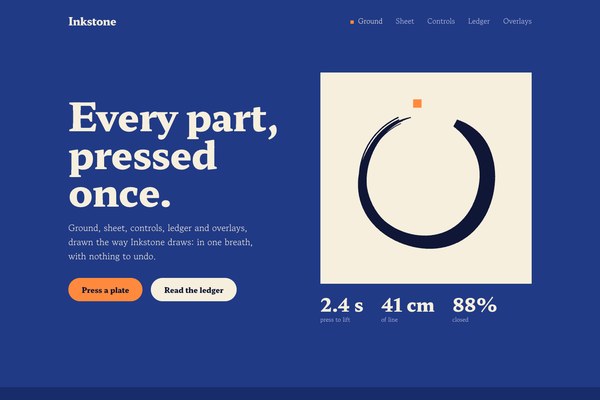
Inkstone is an interface language built on one rule: you get one stroke. Its page is a real sheet of bone paper that you draw on once, hung between a full-bleed indigo ink plate and a staggered three-word spine. Width follows pen speed (slow is heavy, fast is dry), lifting commits the stroke, a persimmon seal lands at the open gap of the ring, and three measured figures (seconds from press to lift, centimetres of line, percent of the circle closed) become the visitor's own. A second press is refused and the sheet nudges until it is re-inked, which wipes the stroke whole. The rest of the page keeps the same discipline: one saturated indigo ground, bone paper and a single persimmon.
Generation 3 of Inkstone, revised in place from arni's approved range 9 take (inkstone-d, 2026-10-07). It keeps the name, the ensō, the single stroke, the brush spine and a seal at the breath gap, and moves the ground from lampblack to saturated indigo.
Spacious. Sections sit 64 to 120px apart with padding above every title, rows have 18 to 28px of padding, and prose is held to about 34rem; the ring and the sheet get far more room than any text.
Phones (390px) stack to one column; the hero plate becomes a portrait image across the top with the headline beneath it, the sheet stays a full-width drawing surface, the spine words drop to 52 to 84px, plates stack, and ledger columns for paper, time and line are hidden. Tablets (834px) keep the staggered spine and two plate columns with square art. From 1440px the content caps and centres.
lampblack
en-019efa9f-b8f5-7e61-8716-41aaf9d688c3
One bone-white ensō brush circle with an open breath-gap on a flat cobalt-indigo plate with a faint paper fibre, a single persimmon seal dot at the gap, a few ink flecks, and calm empty indigo to the left and below for type. The plate inverts Lampblack: bone ink on indigo, with the same loaded sumi-e mass and dry-brush tail.
One full-bleed hero per landing, painted with var(--hero-image) at background-position right center, so the ring sits on the right and the headline in the calm left. Phones use the portrait plate across the top at 100% width with the copy beneath it. The sheet and the plates are drawn in code (SVG and canvas), not generated.
Type or a scrim over the ring, gradients, a second accent colour, a warm paper ground behind the hero, borders or a frame, and any text, letters or logos in the image.
# Inkstone

## Philosophy

Inkstone is an interface language built on one rule: you get one stroke. Its page is a real sheet of bone paper that you draw on once, hung between a full-bleed indigo ink plate and a staggered three-word spine. Width follows pen speed (slow is heavy, fast is dry), lifting commits the stroke, a persimmon seal lands at the open gap of the ring, and three measured figures (seconds from press to lift, centimetres of line, percent of the circle closed) become the visitor's own. A second press is refused and the sheet nudges until it is re-inked, which wipes the stroke whole. The rest of the page keeps the same discipline: one saturated indigo ground, bone paper and a single persimmon.

### Values

- One stroke per sheet: the sheet takes a single stroke, there is no undo, and re-inking wipes it whole.
- The hand sets the weight: pen speed makes a mark heavy or dry, so the line measures the person who drew it.
- The gap is the signature: the ring is left open on purpose and the persimmon seal lands in it, marking the one committed thing.
- Three plain figures: seconds, centimetres and percent closed say what happened in numbers anyone can read.
- One ground, one paper, one seal: indigo, bone and persimmon carry the page, and every semantic colour stays the size of a word.

### Anti-Values

- A near-black lampblack ground with a vermilion chop and a celadon reference mark: this language moved to indigo and a single persimmon.
- Undo, history or a second try on the sheet; a revision is a new sheet.
- Tracked mono eyebrows, invented plate codes and dates, and a colophon footer as ornament.
- A pill bar for navigation, hairline card frames, a scrim over the hero, and a persimmon button with weak contrast.
- A fake hand-drawn doodle where a measured stroke belongs.

### Visual Character

- A full-bleed hero plate: a bone ensō with an open gap on flat indigo, a persimmon seal dot at the gap, and calm indigo to the left and below for the headline.
- One bone sheet laid on the ground, square and borderless, with a canvas you can draw on once.
- Three measured figures in Hahmlet 800 under the sheet, captioned in Gowun Batang.
- A three-word spine (Load, Hold, Lift) at display size, staggered off a tapered bone brush stroke, with one word in persimmon.
- Bone squares for plates, wells and overlays; persimmon only for the seal, the primary action and the checked state; actions are pills and paper is square.

### Lineage

> Generation 3 of Inkstone, revised in place from arni's approved range 9 take (inkstone-d, 2026-10-07). It keeps the name, the ensō, the single stroke, the brush spine and a seal at the breath gap, and moves the ground from lampblack to saturated indigo.

## Tokens

### Colors

| Name | Value |
|------|-------|
| bg | `#213A86` |
| surface | `#182C6C` |
| text | `#F6EFDD` |
| muted | `#C5CBEA` |
| border | `#3D56A8` |
| accent | `#FF8A3D` |
| on_accent | `#101636` |
| success | `#7FD6A8` |
| warning | `#F2C14E` |
| error | `#FF7A6B` |
| info | `#9FB8FF` |
| paper | `#F6EFDD` |
| ink | `#101636` |
| ink_soft | `#3B4272` |
| paper_dim | `#E9E1CC` |

### Derived

- **Tab Hover**: bone at 12% over the ground
- **Quiet Hover**: bone at 14% over the ground
- **Paper Quiet Hover**: ink at 10% over bone
- **Destructive Hover**: error at 16% over the ground
- **Row Hover**: border colour behind a ledger row
- **Refusal Nudge**: translateX -9px at 30%, +7px at 60%, over 350ms, only when motion is allowed
- **Stroke Width**: 28 minus 13 times pen speed in px per ms, never under 2, smoothed at 0.82 old and 0.18 new

### Typography

- **Heading Font**: Hahmlet
- **Body Font**: Gowun Batang
- **Heading Weight**: 800
- **Body Weight**: 400
- **Bold Weight**: 700
- **Button Weight**: 800
- **Heading Transform**: none
- **Letter Spacing**: -0.02em on display, -0.01em on buttons, 0 on body
- **Base Size**: 18px
- **Line Height**: 1.6
- **Scale**: ["14.5px","18px","22px","26px","28px","44px","64px","92px","104px"]
- **Fluid**: Display steps are clamp() values capped at 44, 64, 92 and 104px (the landing hero headline reaches 104px, the embodiment headline 92px); the wordmark is 26px; body floors at 18px and the landing lets it rise to 21px at 1400px and wider.
- **Google Fonts Url**: https://fonts.googleapis.com/css2?family=Hahmlet:wght@500;800&family=Gowun+Batang:wght@400;700&display=swap

### Radii

- **None**: 0px
- **Md**: 0px
- **Lg**: 0px
- **Full**: 9999px

### Shadows

- **None**: No shadows. Overlays are bone paper laid on the ground and read by value, not by blur.

### Spacing

- **Base**: 8px
- **Scale**: ["4px","8px","12px","16px","24px","32px","48px","64px","96px","120px"]

### Surfaces

- **Treatment**: indigo-ground-with-bone-sheets
- **Material**: One saturated indigo ground with a deeper indigo band under it. Bone paper is the only raised-looking material: the drawing sheet, the plates, the input wells, the menu, the dialog and the toast are square bone sheets laid flat on the ground.
- **Card Style**: A card is a bone sheet. It never nests, never has an edge line or a side stripe, and lists, tables and forms sit straight on the ground instead of in a card.
- **Wells**: Input wells are small bone sheets with ink text; a disabled well turns dim bone.
- **Bg Pattern**: none; the ground is flat indigo. The hero plate carries a faint paper fibre inside its raster.

### Borders

- **Default Width**: 0
- **Style**: none
- **Character**: No borders, hairlines or card edges. The only lines are brush strokes: the ring, the tapered spine and the ledger's open rings. Focus is a 3px persimmon outline at 3px offset on the ground and an ink outline on bone.

### Motion

- **Duration**: 150ms
- **Easing**: cubic-bezier(0.2, 0, 0.1, 1)
- **Press**: buttons rise 2px on hover and sink 1px on active; a link's persimmon seal widens from 0 to 8px over 200ms
- **Refusal**: the sheet nudges left 9px then right 7px over 350ms when a second press is made on an inked sheet
- **Philosophy**: Settled first. The page and its example stroke render with no JavaScript; the canvas is the only script, and prefers-reduced-motion removes the nudge, the hover rise and the seal widening.

### Controls

- **Height**: 56px (48 medium, 40 small)
- **Radius**: 9999px for buttons, tabs and the switch; 0 for wells, checkboxes and paper
- **Well Height**: 52px

## Rules

### Composition

- Open the landing with one full-bleed indigo plate: the ring on the right, the headline and one action in the calm left and lower part, with no scrim and nothing laid over the ring.
- Follow the plate with one bone sheet that can really be drawn on: one stroke, no undo, and a Re-ink action that wipes it.
- Hang the three-word spine off a tapered bone brush stroke on the ground, one word per move, staggered, with one word in persimmon.
- Show plates as bone squares on the deeper indigo band, each with a drawn ring, a persimmon seal and a caption that states the measured fact.
- Use no top bar and no card frames; navigation is plain words, and the current word carries a persimmon seal square.

### Hierarchy

- One display line per view in Hahmlet 800 at -0.02em: 56 to 104px for the headline, 72 to 160px for the three spine words, 40 to 64px for the figures.
- Gowun Batang 400 at 18px for prose in two tones, bone for what matters and lavender for the rest; bold 700 only for a name or a number.
- Order comes from size and paper before colour: bone sheets read first, then display type, then the persimmon seal.
- State is a mark and a word: a 12px colour square beside bone text, or an open ring with a persimmon seal at its end.

### Density

Spacious. Sections sit 64 to 120px apart with padding above every title, rows have 18 to 28px of padding, and prose is held to about 34rem; the ring and the sheet get far more room than any text.

### Signature Patterns

- The one stroke: a canvas sheet that takes a single stroke; width is 28 minus 13 times the pen speed in px per ms, never under 2, with dry-brush streaks when it runs fast.
- The seal at the gap: lifting commits the stroke and a 26px persimmon square lands beside the open end of the ring.
- Three measured figures: seconds from press to lift, centimetres of line at screen size, and percent of the circle closed, set in display type.
- The refusal: a second press nudges the sheet 9px left and 7px right over 350ms and changes nothing until Re-ink wipes the sheet.
- The three-word spine: Load, Hold and Lift, staggered off a tapered brush stroke.
- Open rings: progress and plate state are rings that sweep to a value and leave the gap open, with the seal at the end.

## Layout

### Grid

- **Type**: sheet-then-spine landing and a one-column component sheet
- **Max Width**: 1240px content on the embodiment; on the landing only the hero is full width and later sections cap and centre above 1440px
- **Gutter**: 64px desktop, 5vw tablet, 20px phone
- **Column Behavior**: Heads use minmax(0,1fr) minmax(0,1.1fr); the plates use 1.25fr and 1fr with the first plate spanning two rows; every grid child has min-width:0.

### Whitespace

- **Section Gap**: 120px desktop, 64px phone
- **Card Gap**: no card frames; 20 to 40px between plates, 18 to 28px row padding
- **Content Padding**: bone sheets pad 24 to 48px; overlays pad 28 to 48px
- **Approach**: Space and a change of band (ground, deeper indigo, persimmon) separate sections. The ring and the sheet get the most room.

### Density

- **Default**: spacious
- **Spacious**: {"button_height":"56px","input_height":"52px","row_height":"60 to 76px ledger rows"}

### Responsive

Phones (390px) stack to one column; the hero plate becomes a portrait image across the top with the headline beneath it, the sheet stays a full-width drawing surface, the spine words drop to 52 to 84px, plates stack, and ledger columns for paper, time and line are hidden. Tablets (834px) keep the staggered spine and two plate columns with square art. From 1440px the content caps and centres.

### Breakpoints

- **Mobile**: 390px
- **Phone Max**: 700px
- **Tablet**: 800 to 1100px
- **Desktop**: 1280px
- **Wide**: 1440px
- **Ultrawide**: 2560px

## Guidance

### Do

- Start from the indigo ground and one bone sheet; let the ring be the largest mark on the page.
- Let the sheet take one stroke only, and make a second press visibly refused until Re-ink.
- Spend persimmon on the seal, the one primary action per view and the checked state.
- Show the three measured figures in display type and state the measured fact in every plate caption.
- Keep actions as pills and paper as squares, and style every control explicitly.
- Put small error or accent text on the deeper indigo band, where persimmon reaches 5.5:1 and error 5.1:1.

### Don't

- Don't add undo, history or a second stroke to the sheet.
- Don't draw borders, hairlines, shadows, side stripes or nested cards, and don't put a straight bar on any side of a card.
- Don't set small persimmon or coral text on the main indigo ground, where they fall under 4.5:1.
- Don't add eyebrows, plate codes or dates as ornament, or a pill-bar navigation.
- Don't lay a scrim or type over the ring, and don't use emoji on buttons.
- Don't introduce a second accent; the semantic colours stay word-sized marks.

### Accessibility

Bone on indigo is 9.1:1 and on the deeper band 11.3:1; lavender muted is 6.5:1 on the ground. Ink on bone is 15.4:1 and ink soft on bone 8.3:1. The ink label on persimmon is 7.5:1. Persimmon itself is 4.4:1 on the ground (large text and marks only) and 5.5:1 on the deeper band; coral error text is 4.1:1 on the ground and 5.1:1 on the band, so it sits on the band. Every state pairs a mark with a word. Focus is a 3px persimmon outline at 3px offset (ink on bone). Controls are 40 to 56px tall, 52px for wells. The settled page and an example stroke render with no JavaScript, and prefers-reduced-motion removes the nudge, the rise and the widening seal.

### Usage Context

Creative tools, drawing and handwriting products, calligraphy and print studios, commissions and once-only commitments, and any product that wants a decision to feel weighed and final.

## Imagery Direction

### Pairs With

lampblack

### Art Style Id

en-019efa9f-b8f5-7e61-8716-41aaf9d688c3

### Summary

One bone-white ensō brush circle with an open breath-gap on a flat cobalt-indigo plate with a faint paper fibre, a single persimmon seal dot at the gap, a few ink flecks, and calm empty indigo to the left and below for type. The plate inverts Lampblack: bone ink on indigo, with the same loaded sumi-e mass and dry-brush tail.

### Subjects

- a bone-white ensō with an open breath-gap on flat indigo
- one persimmon seal dot at the gap with a few ink flecks
- a portrait variant with the ring in the top half and calm indigo below
- a single bough or a heron as a plate caption subject

### Usage

One full-bleed hero per landing, painted with var(--hero-image) at background-position right center, so the ring sits on the right and the headline in the calm left. Phones use the portrait plate across the top at 100% width with the copy beneath it. The sheet and the plates are drawn in code (SVG and canvas), not generated.

### Avoid

Type or a scrim over the ring, gradients, a second accent colour, a warm paper ground behind the hero, borders or a frame, and any text, letters or logos in the image.
---
version: "alpha"
name: "Inkstone"
description: "Inkstone is an interface language built on one rule: you get one stroke. Its page is a real sheet of bone paper that you draw on once, hung between a full-bleed indigo ink plate and a staggered three-word spine. Width follows pen speed (..."
colors:
  bg: "#213A86"
  surface: "#182C6C"
  text: "#F6EFDD"
  muted: "#C5CBEA"
  border: "#3D56A8"
  accent: "#FF8A3D"
  on_accent: "#101636"
  success: "#7FD6A8"
  warning: "#F2C14E"
  error: "#FF7A6B"
  info: "#9FB8FF"
  paper: "#F6EFDD"
  ink: "#101636"
  ink_soft: "#3B4272"
  paper_dim: "#E9E1CC"
typography:
  headline-lg:
    fontFamily: "Hahmlet"
    fontSize: "2.197rem"
    fontWeight: 700
    lineHeight: 1.1
    letterSpacing: "-0.02em"
  headline-md:
    fontFamily: "Hahmlet"
    fontSize: "1.758rem"
    fontWeight: 600
    lineHeight: 1.15
    letterSpacing: "-0.02em"
  body-md:
    fontFamily: "Gowun Batang"
    fontSize: "18px"
    fontWeight: 400
    lineHeight: 1.5
    letterSpacing: "-0.02em"
  label-md:
    fontFamily: "Gowun Batang"
    fontSize: "0.75rem"
    fontWeight: 600
    lineHeight: 1
    letterSpacing: "0.08em"
rounded:
  none: "0px"
  md: "0px"
  lg: "0px"
  full: "9999px"
spacing:
  base: "8px"
  xs: "4px"
  sm: "8px"
  md: "12px"
  lg: "16px"
  xl: "24px"
  2xl: "32px"
  3xl: "48px"
  4xl: "64px"
  step-8: "96px"
  step-9: "120px"
components:
  color-reference-bg:
    backgroundColor: "{colors.bg}"
  color-reference-surface:
    backgroundColor: "{colors.surface}"
  color-reference-text:
    backgroundColor: "{colors.text}"
  color-reference-muted:
    backgroundColor: "{colors.muted}"
  color-reference-border:
    backgroundColor: "{colors.border}"
  color-reference-accent:
    backgroundColor: "{colors.accent}"
  color-reference-on_accent:
    backgroundColor: "{colors.on_accent}"
  color-reference-success:
    backgroundColor: "{colors.success}"
  color-reference-warning:
    backgroundColor: "{colors.warning}"
  color-reference-error:
    backgroundColor: "{colors.error}"
  color-reference-info:
    backgroundColor: "{colors.info}"
  color-reference-paper:
    backgroundColor: "{colors.paper}"
  color-reference-ink:
    backgroundColor: "{colors.ink}"
  color-reference-ink_soft:
    backgroundColor: "{colors.ink_soft}"
  color-reference-paper_dim:
    backgroundColor: "{colors.paper_dim}"
  button-primary:
    backgroundColor: "{colors.accent}"
    textColor: "{colors.on_accent}"
    typography: "{typography.label-md}"
    rounded: "{rounded.md}"
    padding: "{spacing.md}"
  card-surface:
    backgroundColor: "{colors.surface}"
    textColor: "{colors.text}"
    rounded: "{rounded.md}"
    padding: "{spacing.md}"
  input-default:
    backgroundColor: "{colors.surface}"
    textColor: "{colors.text}"
    rounded: "{rounded.md}"
    height: "44px"
---

# Inkstone

## Overview

Inkstone is an interface language built on one rule: you get one stroke. Its page is a real sheet of bone paper that you draw on once, hung between a full-bleed indigo ink plate and a staggered three-word spine. Width follows pen speed (slow is heavy, fast is dry), lifting commits the stroke, a persimmon seal lands at the open gap of the ring, and three measured figures (seconds from press to lift, centimetres of line, percent of the circle closed) become the visitor's own. A second press is refused and the sheet nudges until it is re-inked, which wipes the stroke whole. The rest of the page keeps the same discipline: one saturated indigo ground, bone paper and a single persimmon.

### Values

- One stroke per sheet: the sheet takes a single stroke, there is no undo, and re-inking wipes it whole.
- The hand sets the weight: pen speed makes a mark heavy or dry, so the line measures the person who drew it.
- The gap is the signature: the ring is left open on purpose and the persimmon seal lands in it, marking the one committed thing.
- Three plain figures: seconds, centimetres and percent closed say what happened in numbers anyone can read.
- One ground, one paper, one seal: indigo, bone and persimmon carry the page, and every semantic colour stays the size of a word.

### Anti-Values

- A near-black lampblack ground with a vermilion chop and a celadon reference mark: this language moved to indigo and a single persimmon.
- Undo, history or a second try on the sheet; a revision is a new sheet.
- Tracked mono eyebrows, invented plate codes and dates, and a colophon footer as ornament.
- A pill bar for navigation, hairline card frames, a scrim over the hero, and a persimmon button with weak contrast.
- A fake hand-drawn doodle where a measured stroke belongs.

### Visual Character

- A full-bleed hero plate: a bone ensō with an open gap on flat indigo, a persimmon seal dot at the gap, and calm indigo to the left and below for the headline.
- One bone sheet laid on the ground, square and borderless, with a canvas you can draw on once.
- Three measured figures in Hahmlet 800 under the sheet, captioned in Gowun Batang.
- A three-word spine (Load, Hold, Lift) at display size, staggered off a tapered bone brush stroke, with one word in persimmon.
- Bone squares for plates, wells and overlays; persimmon only for the seal, the primary action and the checked state; actions are pills and paper is square.

### Lineage

> Generation 3 of Inkstone, revised in place from arni's approved range 9 take (inkstone-d, 2026-10-07). It keeps the name, the ensō, the single stroke, the brush spine and a seal at the breath gap, and moves the ground from lampblack to saturated indigo.

## Colors

Use the YAML color tokens as the normative palette. The prose below names the roles agents should preserve when generating UI.

| Token | Value |
|-------|-------|
| bg | `#213A86` |
| surface | `#182C6C` |
| text | `#F6EFDD` |
| muted | `#C5CBEA` |
| border | `#3D56A8` |
| accent | `#FF8A3D` |
| on_accent | `#101636` |
| success | `#7FD6A8` |
| warning | `#F2C14E` |
| error | `#FF7A6B` |
| info | `#9FB8FF` |
| paper | `#F6EFDD` |
| ink | `#101636` |
| ink_soft | `#3B4272` |
| paper_dim | `#E9E1CC` |

## Typography

Load the fonts from Google Fonts: https://fonts.googleapis.com/css2?family=Hahmlet:wght@500;800&family=Gowun+Batang:wght@400;700&display=swap

- **Headline-Lg**: Hahmlet, 2.197rem, weight 700, line-height 1.1.
- **Headline-Md**: Hahmlet, 1.758rem, weight 600, line-height 1.15.
- **Body-Md**: Gowun Batang, 18px, weight 400, line-height 1.5.
- **Label-Md**: Gowun Batang, 0.75rem, weight 600, line-height 1.

## Layout

### Spacing Tokens

- **Base**: `8px`
- **Xs**: `4px`
- **Sm**: `8px`
- **Md**: `12px`
- **Lg**: `16px`
- **Xl**: `24px`
- **2xl**: `32px`
- **3xl**: `48px`
- **4xl**: `64px`
- **Step-8**: `96px`
- **Step-9**: `120px`

### Grid

- **Type**: sheet-then-spine landing and a one-column component sheet
- **Max Width**: 1240px content on the embodiment; on the landing only the hero is full width and later sections cap and centre above 1440px
- **Gutter**: 64px desktop, 5vw tablet, 20px phone
- **Column Behavior**: Heads use minmax(0,1fr) minmax(0,1.1fr); the plates use 1.25fr and 1fr with the first plate spanning two rows; every grid child has min-width:0.

### Whitespace

- **Section Gap**: 120px desktop, 64px phone
- **Card Gap**: no card frames; 20 to 40px between plates, 18 to 28px row padding
- **Content Padding**: bone sheets pad 24 to 48px; overlays pad 28 to 48px
- **Approach**: Space and a change of band (ground, deeper indigo, persimmon) separate sections. The ring and the sheet get the most room.

### Density

- **Default**: spacious
- **Spacious**: {"button_height":"56px","input_height":"52px","row_height":"60 to 76px ledger rows"}

### Responsive

Phones (390px) stack to one column; the hero plate becomes a portrait image across the top with the headline beneath it, the sheet stays a full-width drawing surface, the spine words drop to 52 to 84px, plates stack, and ledger columns for paper, time and line are hidden. Tablets (834px) keep the staggered spine and two plate columns with square art. From 1440px the content caps and centres.

### Breakpoints

- **Mobile**: 390px
- **Phone Max**: 700px
- **Tablet**: 800 to 1100px
- **Desktop**: 1280px
- **Wide**: 1440px
- **Ultrawide**: 2560px

## Elevation & Depth

### Shadows

- **None**: No shadows. Overlays are bone paper laid on the ground and read by value, not by blur.

## Shapes

### Rounded

- **None**: `0px`
- **Md**: `0px`
- **Lg**: `0px`
- **Full**: `9999px`

### Surfaces

- **Treatment**: indigo-ground-with-bone-sheets
- **Material**: One saturated indigo ground with a deeper indigo band under it. Bone paper is the only raised-looking material: the drawing sheet, the plates, the input wells, the menu, the dialog and the toast are square bone sheets laid flat on the ground.
- **Card Style**: A card is a bone sheet. It never nests, never has an edge line or a side stripe, and lists, tables and forms sit straight on the ground instead of in a card.
- **Wells**: Input wells are small bone sheets with ink text; a disabled well turns dim bone.
- **Bg Pattern**: none; the ground is flat indigo. The hero plate carries a faint paper fibre inside its raster.

### Borders

- **Default Width**: 0
- **Style**: none
- **Character**: No borders, hairlines or card edges. The only lines are brush strokes: the ring, the tapered spine and the ledger's open rings. Focus is a 3px persimmon outline at 3px offset on the ground and an ink outline on bone.

## Components

### Composition

- Open the landing with one full-bleed indigo plate: the ring on the right, the headline and one action in the calm left and lower part, with no scrim and nothing laid over the ring.
- Follow the plate with one bone sheet that can really be drawn on: one stroke, no undo, and a Re-ink action that wipes it.
- Hang the three-word spine off a tapered bone brush stroke on the ground, one word per move, staggered, with one word in persimmon.
- Show plates as bone squares on the deeper indigo band, each with a drawn ring, a persimmon seal and a caption that states the measured fact.
- Use no top bar and no card frames; navigation is plain words, and the current word carries a persimmon seal square.

### Hierarchy

- One display line per view in Hahmlet 800 at -0.02em: 56 to 104px for the headline, 72 to 160px for the three spine words, 40 to 64px for the figures.
- Gowun Batang 400 at 18px for prose in two tones, bone for what matters and lavender for the rest; bold 700 only for a name or a number.
- Order comes from size and paper before colour: bone sheets read first, then display type, then the persimmon seal.
- State is a mark and a word: a 12px colour square beside bone text, or an open ring with a persimmon seal at its end.

### Density

Spacious. Sections sit 64 to 120px apart with padding above every title, rows have 18 to 28px of padding, and prose is held to about 34rem; the ring and the sheet get far more room than any text.

### Signature Patterns

- The one stroke: a canvas sheet that takes a single stroke; width is 28 minus 13 times the pen speed in px per ms, never under 2, with dry-brush streaks when it runs fast.
- The seal at the gap: lifting commits the stroke and a 26px persimmon square lands beside the open end of the ring.
- Three measured figures: seconds from press to lift, centimetres of line at screen size, and percent of the circle closed, set in display type.
- The refusal: a second press nudges the sheet 9px left and 7px right over 350ms and changes nothing until Re-ink wipes the sheet.
- The three-word spine: Load, Hold and Lift, staggered off a tapered brush stroke.
- Open rings: progress and plate state are rings that sweep to a value and leave the gap open, with the seal at the end.

## shadcn/ui Usage

When the target app uses shadcn/ui, copy DESIGN.md with shadcn instead of the plain DESIGN.md. It contains the same Katagami design-language source plus the shadcn/ui primitives, imports, theme variables, component recipes, and preview-shot guidance.

DESIGN.md with shadcn: `/language/en-01a1379a-1b65-7b80-9e91-d0e5efd6cd7c/DESIGN.with-shadcn.md`.

Machine-readable companions for automation: `/language/en-01a1379a-1b65-7b80-9e91-d0e5efd6cd7c/shadcn.json` (registry theme), `/language/en-01a1379a-1b65-7b80-9e91-d0e5efd6cd7c/shadcn-components.md` (component recipes) and `/language/en-01a1379a-1b65-7b80-9e91-d0e5efd6cd7c/shadcn-shots.json` (preview shots). The human-facing handoff is still DESIGN.md with shadcn.

Install recommended primitives with `npx shadcn@latest add button card input textarea select dialog sheet tabs badge separator checkbox switch slider tooltip dropdown-menu table`.

Use these primitives in shadcn apps:
- button
- card
- input
- textarea
- select
- dialog
- sheet
- tabs
- badge
- separator
- checkbox
- switch
- slider
- tooltip
- dropdown-menu
- table

Implementation rule for agents: import shadcn primitives from `@/components/ui/*`, apply the generated CSS variables first, then compose the language-specific recipes from the companion MD. Katagami remains the source of truth; shadcn names are the implementation surface.

## Do's and Don'ts

- Do Start from the indigo ground and one bone sheet; let the ring be the largest mark on the page.
- Do Let the sheet take one stroke only, and make a second press visibly refused until Re-ink.
- Do Spend persimmon on the seal, the one primary action per view and the checked state.
- Do Show the three measured figures in display type and state the measured fact in every plate caption.
- Do Keep actions as pills and paper as squares, and style every control explicitly.
- Do Put small error or accent text on the deeper indigo band, where persimmon reaches 5.5:1 and error 5.1:1.
- Don't Don't add undo, history or a second stroke to the sheet.
- Don't Don't draw borders, hairlines, shadows, side stripes or nested cards, and don't put a straight bar on any side of a card.
- Don't Don't set small persimmon or coral text on the main indigo ground, where they fall under 4.5:1.
- Don't Don't add eyebrows, plate codes or dates as ornament, or a pill-bar navigation.
- Don't Don't lay a scrim or type over the ring, and don't use emoji on buttons.
- Don't Don't introduce a second accent; the semantic colours stay word-sized marks.

### Accessibility

Bone on indigo is 9.1:1 and on the deeper band 11.3:1; lavender muted is 6.5:1 on the ground. Ink on bone is 15.4:1 and ink soft on bone 8.3:1. The ink label on persimmon is 7.5:1. Persimmon itself is 4.4:1 on the ground (large text and marks only) and 5.5:1 on the deeper band; coral error text is 4.1:1 on the ground and 5.1:1 on the band, so it sits on the band. Every state pairs a mark with a word. Focus is a 3px persimmon outline at 3px offset (ink on bone). Controls are 40 to 56px tall, 52px for wells. The settled page and an example stroke render with no JavaScript, and prefers-reduced-motion removes the nudge, the rise and the widening seal.

### Usage Context

Creative tools, drawing and handwriting products, calligraphy and print studios, commissions and once-only commitments, and any product that wants a decision to feel weighed and final.

## Imagery Direction

### Pairs With

lampblack

### Art Style Id

en-019efa9f-b8f5-7e61-8716-41aaf9d688c3

### Summary

One bone-white ensō brush circle with an open breath-gap on a flat cobalt-indigo plate with a faint paper fibre, a single persimmon seal dot at the gap, a few ink flecks, and calm empty indigo to the left and below for type. The plate inverts Lampblack: bone ink on indigo, with the same loaded sumi-e mass and dry-brush tail.

### Subjects

- a bone-white ensō with an open breath-gap on flat indigo
- one persimmon seal dot at the gap with a few ink flecks
- a portrait variant with the ring in the top half and calm indigo below
- a single bough or a heron as a plate caption subject

### Usage

One full-bleed hero per landing, painted with var(--hero-image) at background-position right center, so the ring sits on the right and the headline in the calm left. Phones use the portrait plate across the top at 100% width with the copy beneath it. The sheet and the plates are drawn in code (SVG and canvas), not generated.

### Avoid

Type or a scrim over the ring, gradients, a second accent colour, a warm paper ground behind the hero, borders or a frame, and any text, letters or logos in the image.
```json
{
  "$schema": "https://ui.shadcn.com/schema/registry-item.json",
  "name": "inkstone",
  "type": "registry:theme",
  "title": "Inkstone shadcn Theme",
  "cssVars": {
    "theme": {},
    "light": {
      "background": "#213A86",
      "foreground": "#F6EFDD",
      "card": "#182C6C",
      "card-foreground": "#F6EFDD",
      "popover": "#182C6C",
      "popover-foreground": "#F6EFDD",
      "primary": "#F6EFDD",
      "primary-foreground": "#111111",
      "secondary": "#f4f4f5",
      "secondary-foreground": "#111111",
      "muted": "#C5CBEA",
      "muted-foreground": "#F6EFDD",
      "accent": "#FF8A3D",
      "accent-foreground": "#ffffff",
      "destructive": "#FF7A6B",
      "border": "#3D56A8",
      "input": "#3D56A8",
      "ring": "#FF8A3D",
      "chart-1": "#F6EFDD",
      "chart-2": "#f4f4f5",
      "chart-3": "#FF8A3D",
      "chart-4": "#7FD6A8",
      "chart-5": "#F2C14E",
      "sidebar": "#182C6C",
      "sidebar-foreground": "#F6EFDD",
      "sidebar-primary": "#F6EFDD",
      "sidebar-primary-foreground": "#111111",
      "sidebar-accent": "#9FB8FF",
      "sidebar-accent-foreground": "#ffffff",
      "sidebar-border": "#3D56A8",
      "sidebar-ring": "#FF8A3D",
      "radius": "0px"
    },
    "dark": {
      "background": "#0f1115",
      "foreground": "#f8fafc",
      "card": "#181b22",
      "card-foreground": "#f8fafc",
      "popover": "#181b22",
      "popover-foreground": "#f8fafc",
      "primary": "#F6EFDD",
      "primary-foreground": "#111111",
      "secondary": "#252a33",
      "secondary-foreground": "#f8fafc",
      "muted": "#252a33",
      "muted-foreground": "#a1a1aa",
      "accent": "#FF8A3D",
      "accent-foreground": "#ffffff",
      "destructive": "#FF7A6B",
      "border": "#303642",
      "input": "#303642",
      "ring": "#FF8A3D",
      "chart-1": "#F6EFDD",
      "chart-2": "#f4f4f5",
      "chart-3": "#FF8A3D",
      "chart-4": "#7FD6A8",
      "chart-5": "#F2C14E",
      "sidebar": "#181b22",
      "sidebar-foreground": "#f8fafc",
      "sidebar-primary": "#F6EFDD",
      "sidebar-primary-foreground": "#111111",
      "sidebar-accent": "#FF8A3D",
      "sidebar-accent-foreground": "#ffffff",
      "sidebar-border": "#303642",
      "sidebar-ring": "#FF8A3D",
      "radius": "0px"
    }
  },
  "meta": {
    "source": "katagami",
    "languageId": "en-01a1379a-1b65-7b80-9e91-d0e5efd6cd7c",
    "slug": "inkstone",
    "componentManifest": [
      "button",
      "card",
      "input",
      "textarea",
      "select",
      "dialog",
      "sheet",
      "tabs",
      "badge",
      "separator",
      "checkbox",
      "switch",
      "slider",
      "tooltip",
      "dropdown-menu",
      "table"
    ],
    "installCommand": "npx shadcn@latest add button card input textarea select dialog sheet tabs badge separator checkbox switch slider tooltip dropdown-menu table",
    "nativeTokenNames": {
      "colors": [
        "accent",
        "bg",
        "border",
        "error",
        "info",
        "ink",
        "ink_soft",
        "muted",
        "on_accent",
        "paper",
        "paper_dim",
        "success",
        "surface",
        "text",
        "warning"
      ],
      "derived": [
        "destructive_hover",
        "paper_quiet_hover",
        "quiet_hover",
        "refusal_nudge",
        "row_hover",
        "stroke_width",
        "tab_hover"
      ],
      "typography": [
        "base_size",
        "body_font",
        "body_weight",
        "bold_weight",
        "button_weight",
        "fluid",
        "google_fonts_url",
        "heading_font",
        "heading_transform",
        "heading_weight",
        "letter_spacing",
        "line_height",
        "scale"
      ],
      "radii": [
        "full",
        "lg",
        "md",
        "none"
      ],
      "shadows": [
        "none"
      ],
      "spacing": [
        "base",
        "scale"
      ],
      "surfaces": [
        "bg_pattern",
        "card_style",
        "material",
        "treatment",
        "wells"
      ],
      "borders": [
        "character",
        "default_width",
        "style"
      ],
      "motion": [
        "duration",
        "easing",
        "philosophy",
        "press",
        "refusal"
      ],
      "controls": [
        "height",
        "radius",
        "well_height"
      ]
    }
  }
}
```The art style its pictures are drawn in and the colours its tokens carry.
The theme variables are generated from the tokens. Component recipes and preview shots have not been written for this language yet.
For an app that uses shadcn/ui: the DESIGN.md plus the install list, theme variables, component recipes, preview shots and a starter TSX file, in one Markdown file.
The same pieces as separate files: theme, CSS, TSX starter, recipes and the preview contract.
npx shadcn@latest add button card input textarea select dialog sheet tabs badge separator checkbox switch slider tooltip dropdown-menu table:root {
--background: #213A86;
--foreground: #F6EFDD;
--card: #182C6C;
--card-foreground: #F6EFDD;
--popover: #182C6C;
--popover-foreground: #F6EFDD;
--primary: #F6EFDD;
--primary-foreground: #111111;
--secondary: #f4f4f5;
--secondary-foreground: #111111;
--muted: #C5CBEA;
--muted-foreground: #F6EFDD;
--accent: #FF8A3D;
--accent-foreground: #ffffff;
--destructive: #FF7A6B;
--border: #3D56A8;
--input: #3D56A8;
--ring: #FF8A3D;
--chart-1: #F6EFDD;
--chart-2: #f4f4f5;
--chart-3: #FF8A3D;
--chart-4: #7FD6A8;
--chart-5: #F2C14E;
--sidebar: #182C6C;
--sidebar-foreground: #F6EFDD;
--sidebar-primary: #F6EFDD;
--sidebar-primary-foreground: #111111;
--sidebar-accent: #9FB8FF;
--sidebar-accent-foreground: #ffffff;
--sidebar-border: #3D56A8;
--sidebar-ring: #FF8A3D;
--radius: 0px;
}
.dark {
--background: #0f1115;
--foreground: #f8fafc;
--card: #181b22;
--card-foreground: #f8fafc;
--popover: #181b22;
--popover-foreground: #f8fafc;
--primary: #F6EFDD;
--primary-foreground: #111111;
--secondary: #252a33;
--secondary-foreground: #f8fafc;
--muted: #252a33;
--muted-foreground: #a1a1aa;
--accent: #FF8A3D;
--accent-foreground: #ffffff;
--destructive: #FF7A6B;
--border: #303642;
--input: #303642;
--ring: #FF8A3D;
--chart-1: #F6EFDD;
--chart-2: #f4f4f5;
--chart-3: #FF8A3D;
--chart-4: #7FD6A8;
--chart-5: #F2C14E;
--sidebar: #181b22;
--sidebar-foreground: #f8fafc;
--sidebar-primary: #F6EFDD;
--sidebar-primary-foreground: #111111;
--sidebar-accent: #FF8A3D;
--sidebar-accent-foreground: #ffffff;
--sidebar-border: #303642;
--sidebar-ring: #FF8A3D;
--radius: 0px;
}
import { Badge } from "@/components/ui/badge";
import { Button } from "@/components/ui/button";
import {
  Card,
  CardContent,
  CardDescription,
  CardFooter,
  CardHeader,
  CardTitle,
} from "@/components/ui/card";
import { Input } from "@/components/ui/input";
import { Tabs, TabsList, TabsTrigger } from "@/components/ui/tabs";

export function InkstoneShadcnKit() {
  return (
    <section className="grid gap-4 rounded-[var(--radius)] border bg-background p-4 text-foreground">
      <div className="flex items-start justify-between gap-4">
        <div>
          <Badge variant="outline">shadcn/ui</Badge>
          <h2 className="mt-3 text-2xl font-semibold tracking-tight">Inkstone</h2>
          <p className="mt-1 max-w-xl text-sm text-muted-foreground">
            Use the Katagami registry theme, then compose these shadcn primitives
            with the language-specific component recipes.
          </p>
        </div>
        <Button>Apply theme</Button>
      </div>

      <Tabs defaultValue="components">
        <TabsList>
          <TabsTrigger value="components">Components</TabsTrigger>
          <TabsTrigger value="states">States</TabsTrigger>
          <TabsTrigger value="export">Export</TabsTrigger>
        </TabsList>
      </Tabs>

      <Card>
        <CardHeader>
          <CardTitle>Component recipe</CardTitle>
          <CardDescription>
            Replace this starter content with the agent-authored product scene
            from components.md and preview-shots.json.
          </CardDescription>
        </CardHeader>
        <CardContent className="grid gap-3 sm:grid-cols-[1fr_auto]">
          <Input defaultValue="Tokenized shadcn surface" aria-label="Recipe name" />
          <Button variant="secondary">Preview state</Button>
        </CardContent>
        <CardFooter className="justify-between">
          <Badge>Ready</Badge>
          <Button variant="outline">Copy recipe</Button>
        </CardFooter>
      </Card>
    </section>
  );
}
{
  "$schema": "https://ui.shadcn.com/schema/registry-item.json",
  "name": "inkstone",
  "type": "registry:theme",
  "title": "Inkstone",
  "description": "A saturated indigo ground, one bone sheet and one persimmon seal: square paper, pill actions, no borders and no shadows.",
  "cssVars": {
    "theme": {
      "font-sans": "Gowun Batang, serif",
      "font-mono": "Gowun Batang, serif",
      "font-display": "Hahmlet, serif",
      "radius": "0px"
    },
    "light": {
      "background": "#213A86",
      "foreground": "#F6EFDD",
      "card": "#F6EFDD",
      "card-foreground": "#101636",
      "popover": "#F6EFDD",
      "popover-foreground": "#101636",
      "primary": "#FF8A3D",
      "primary-foreground": "#101636",
      "secondary": "#F6EFDD",
      "secondary-foreground": "#101636",
      "muted": "#182C6C",
      "muted-foreground": "#C5CBEA",
      "accent": "#E9E1CC",
      "accent-foreground": "#101636",
      "destructive": "#FF7A6B",
      "destructive-foreground": "#101636",
      "border": "transparent",
      "input": "transparent",
      "ring": "#FF8A3D",
      "chart-1": "#FF8A3D",
      "chart-2": "#F6EFDD",
      "chart-3": "#9FB8FF",
      "chart-4": "#7FD6A8",
      "chart-5": "#F2C14E",
      "radius": "0px"
    },
    "dark": {
      "background": "#213A86",
      "foreground": "#F6EFDD",
      "card": "#F6EFDD",
      "card-foreground": "#101636",
      "popover": "#F6EFDD",
      "popover-foreground": "#101636",
      "primary": "#FF8A3D",
      "primary-foreground": "#101636",
      "secondary": "#F6EFDD",
      "secondary-foreground": "#101636",
      "muted": "#182C6C",
      "muted-foreground": "#C5CBEA",
      "accent": "#E9E1CC",
      "accent-foreground": "#101636",
      "destructive": "#FF7A6B",
      "destructive-foreground": "#101636",
      "border": "transparent",
      "input": "transparent",
      "ring": "#FF8A3D",
      "chart-1": "#FF8A3D",
      "chart-2": "#F6EFDD",
      "chart-3": "#9FB8FF",
      "chart-4": "#7FD6A8",
      "chart-5": "#F2C14E",
      "radius": "0px"
    }
  },
  "componentManifest": [
    "button",
    "card",
    "input",
    "textarea",
    "select",
    "dialog",
    "sheet",
    "tabs",
    "badge",
    "separator",
    "checkbox",
    "switch",
    "slider",
    "tooltip",
    "dropdown-menu",
    "table"
  ],
  "meta": {
    "nativeTokenNames": {
      "bg": "background",
      "surface": "muted (the deeper band)",
      "text": "foreground",
      "muted": "muted-foreground",
      "accent": "primary / ring / chart-1 (the seal)",
      "on_accent": "primary-foreground",
      "paper": "card / popover / secondary (bone sheets)",
      "ink": "card-foreground / popover-foreground / secondary-foreground",
      "ink_soft": "native only (copy on paper)",
      "paper_dim": "accent (highlight on paper)",
      "error": "destructive",
      "border": "native only (tracks, switch off, row hover); --border stays transparent",
      "success": "chart-4",
      "warning": "chart-5",
      "info": "chart-3"
    },
    "note": "Inkstone is a saturated indigo language; the dark scope repeats the light values. The shadcn primary is the persimmon seal and secondary is bone paper. Card and popover are bone sheets with ink text, so buttons placed on a card use the ink variant.",
    "componentManifest": [
      "button",
      "card",
      "input",
      "textarea",
      "select",
      "dialog",
      "sheet",
      "tabs",
      "badge",
      "separator",
      "checkbox",
      "switch",
      "slider",
      "tooltip",
      "dropdown-menu",
      "table"
    ]
  }
}
---
artifact: component-recipes-v1
language: inkstone
author: katagami-agent
primitives: 16
---

# Inkstone shadcn/ui Components

Author: `katagami-agent`

## Intent

Inkstone dresses shadcn/ui as a saturated indigo ground with bone paper laid on it and one persimmon seal. Cards, wells, menus, dialogs and tooltips are square bone sheets with ink text; actions are persimmon or bone pills; nothing has a border or a shadow. The signature is a sheet you draw on once: pen speed sets the width, lifting commits it, a persimmon seal lands at the open gap of the ring, and three measured figures (seconds, centimetres, percent closed) are yours.

## Required primitives

button, card, input, textarea, select, dialog, sheet, tabs, badge, separator, checkbox, switch, slider, tooltip, dropdown-menu, table. Import them from `@/components/ui/*`; do not build a second component system.

## Token cues

```css
--background:#213A86;
--foreground:#F6EFDD;
--card:#F6EFDD;
--card-foreground:#101636;
--popover:#F6EFDD;
--popover-foreground:#101636;
--primary:#FF8A3D;
--primary-foreground:#101636;
--secondary:#F6EFDD;
--secondary-foreground:#101636;
--muted:#182C6C;
--muted-foreground:#C5CBEA;
--accent:#E9E1CC;
--accent-foreground:#101636;
--destructive:#FF7A6B;
--destructive-foreground:#101636;
--border:transparent;
--input:transparent;
--ring:#FF8A3D;
--chart-1:#FF8A3D;
--chart-2:#F6EFDD;
--chart-3:#9FB8FF;
--chart-4:#7FD6A8;
--chart-5:#F2C14E;
--radius:0px;
```

Native names are kept in the theme: `bg`, `surface`, `paper`, `ink`, `ink_soft`, `paper_dim` and the seal `accent` `#FF8A3D`, which is the shadcn primary.

## Visual character to preserve

- One stroke per sheet: the drawing sheet is its own component outside shadcn, and a second press is refused until Re-ink.
- Paper is square and actions are pills: cards, wells, menus and dialogs use radius 0; buttons, tabs and the switch are `rounded-full`.
- No borders, no shadows, no nested cards, no side stripes: sections separate by a change of band and by space.
- Persimmon only for the seal, the one primary action per view and the checked state; small accent and error text sits on the deeper band.
- Hahmlet 800 for headlines, figures and buttons; Gowun Batang 400 at 18px for everything you read.
- Every state is a mark and a word; progress is an open ring with the seal at its end.

## ShadSync visual profile

- family: paper-object
- material: bone paper sheets laid flat on a saturated indigo ground
- contour: square paper, pill actions
- border: none
- underlay: False
- grain: False
- stickerBadges: False
- motion: rise on hover, nudge on refusal
- density: spacious
- radius: 0, 9999
- accents: persimmon-seal

## Signature component recipes

- **button:** `h-14 rounded-full px-8 border-0 font-[Hahmlet] font-extrabold text-[18px] tracking-[-0.01em] whitespace-nowrap`. `default` is `bg-primary text-primary-foreground` (persimmon with an ink label), one per view; it rises `-translate-y-0.5` on hover and sinks `translate-y-px` on active. `secondary` is the bone pill (`bg-secondary text-secondary-foreground`). `ghost` is a bone word that tints `hover:bg-foreground/15`. `destructive` is a coral word, `bg-transparent text-destructive hover:bg-destructive/15`, never a solid block. Sizes: default `h-14`, `md` `h-12 px-[26px]`, `sm` `h-10 px-5`. Focus: `outline-[3px] outline-offset-[3px] outline-ring`.
- **card:** A card is a sheet of bone paper laid on the ground: `bg-card text-card-foreground rounded-none border-0 shadow-none p-6 gap-4`. The plate and the drawing sheet are cards. Never nest one, never add an edge line or a side stripe, and never wrap a list, a table or a form in one: those sit straight on the ground.
- **input:** a small sheet of paper: `h-[52px] rounded-none border-0 bg-popover text-popover-foreground px-[18px] text-[18px] shadow-none placeholder:text-[#3B4272]`. Focus is `outline-[3px] outline-offset-[3px] outline-ring`. An error keeps the sheet and prints its message beneath in `text-destructive`, on the deeper band.
- **textarea:** the input sheet at `min-h-[124px] py-3.5 leading-[1.4]`, vertical resize only.
- **select:** the input sheet with a 14px ink SVG chevron on the right; `SelectContent` is `bg-popover text-popover-foreground rounded-none p-0 shadow-none`; items are square rows `px-6 py-3` that take `bg-accent` when highlighted.
- **dialog:** `bg-popover text-popover-foreground rounded-none p-12 border-0 shadow-none` over a 55% indigo overlay (`bg-background/55`); a Hahmlet title, an ink-soft body, one persimmon button and a quiet ink word (Re-ink it).
- **sheet:** a right-side `bg-popover text-popover-foreground rounded-none` panel that slides in over 250ms on `cubic-bezier(.2,0,.1,1)`; the three measured figures print in Hahmlet at the top and the details in Gowun Batang below. It is paper, not a shadowed drawer.
- **tabs:** `TabsList` has no tray: `bg-transparent p-0 gap-1.5`. Triggers are 44px pills in `text-muted-foreground`, and the active trigger takes `bg-secondary text-secondary-foreground rounded-full`. No underline.
- **badge:** a mark and a word, not a pill: `bg-transparent p-0 text-[18px]` with a 12px square before it (`before:size-3 before:bg-[var(--c)]`). Sealed is mint, Drying ochre, Held periwinkle, Refused coral; the word stays bone.
- **separator:** do not draw one. Space does the separating (18 to 28px row padding, 64 to 120px between sections), and the only straight edge is the change of band between the ground and the deeper indigo.
- **checkbox:** `size-6 rounded-none border-0 bg-popover`; checked fills `bg-primary` with a drawn ink tick (an SVG, not a border). Radios are the same at `rounded-full` with an ink dot.
- **switch:** a pill track `w-[52px] h-[30px] rounded-full bg-[#3D56A8]` with a 22px bone knob; checked turns the track persimmon and the knob ink, sliding 22px on `cubic-bezier(.2,0,.1,1)`.
- **slider:** a 6px pill track in `#3D56A8` with a 24px square persimmon thumb (the seal) and no filled range; the reading prints beneath in Gowun Batang 14.5px (70% loaded).
- **tooltip:** `bg-popover text-popover-foreground rounded-none px-4 py-3 text-[14.5px] shadow-none`, no arrow, set beside a persimmon seal square.
- **dropdown-menu:** `bg-popover text-popover-foreground rounded-none py-3 shadow-none`; rows are `px-6 py-3` with the name in Hahmlet 800 at 18px and a description in Gowun Batang 14.5px `text-[#3B4272]`; the highlighted row takes `bg-accent`.
- **table:** the plate ledger on the deeper band. Rows sit on the page with no dividers, odd rows `bg-background`, hover `bg-[#3D56A8]`; heads are 14.5px 700 in `text-muted-foreground`; the Closed column pairs an open ring (an SVG circle with `pathLength=100` and a `stroke-dasharray`) with the percent. Hide Paper, Press to lift and Line below 640px.

### The sheet and the seal (the signature, outside shadcn)

The sheet is not a shadcn primitive. Build it once: a bone `<div>` with a `<canvas>` sized to it (`touch-action: none`, crosshair cursor). On `pointerdown` start one stroke; on `pointermove` set the width to `28 - 13 * v` (v is pixels per millisecond, minimum 2) smoothed as `w = w * .82 + target * .18`, and draw a round-capped segment. On `pointerup` compute seconds from press to lift, centimetres as pixels times 0.02646, and percent closed as one minus the gap between the first and last point over the stroke's diagonal; print them in Hahmlet 800 and place a 26px persimmon square beside the end point. A second `pointerdown` nudges the sheet (9px left, then 7px right over 350ms, skipped under reduced motion) and changes nothing until Re-ink clears the canvas. Render a settled example stroke as inline SVG so the page reads with no JavaScript.

## Preview shots

- `application-shell`: The plate ledger. Plain-word navigation on the indigo ground, a Hahmlet headline and one persimmon button, the sealed heron plate as a bone card with its open ring and three figures, then the ledger on the deeper band with a mark and a word for each state.
- `detail-editor`: Commission a plate. A commission slip on the deeper band: bone input sheets for name and subject, a paper choice, a brief textarea, the brush-load slider with its square seal thumb, a switch, a checkbox, one persimmon button and a quiet word.
- `data-operations`: The sheet and its overlays. Pill tabs for This season, Last season and Held, the sheet-actions menu open as a bone square, the ledger rows below, a side sheet of plate figures and a dialog asking whether to Re-ink the sheet.

Each shot carries a renderable `scene` with headline, description, actions and rows or fields.

## Implementation contract

- Start from local `@/components/ui/*` shadcn primitives and apply `/katagami/shadcn/inkstone/registry-theme.json`.
- Keep `--border` and `--input` transparent; wells are small bone sheets (`bg-popover`), never outlined boxes.
- Set `--radius: 0px` for paper (cards, wells, menus, dialogs, tooltips) and use `rounded-full` only for buttons, tabs and the switch.
- One `default` persimmon button per view; a second action is the bone secondary or a quiet word, and destructive is a coral word.
- No shadows, no borders, no nested cards; the checked state is always persimmon.
- Build the drawing sheet and the seal as their own component outside shadcn, and show progress as an open ring.
- Respect `prefers-reduced-motion`: skip the nudge and the hover rise; the settled example stroke renders without JavaScript.

## Copy-paste component example

```tsx
import { Button } from "@/components/ui/button";
import { Card } from "@/components/ui/card";
import { Badge } from "@/components/ui/badge";

const plates = [
  { name: "Heron over reed bank", paper: "Hemp", closed: 85, state: "Sealed", mark: "#7FD6A8" },
  { name: "Pine, single bough", paper: "Mulberry", closed: 79, state: "Drying", mark: "#F2C14E" },
  { name: "Carp with one fin", paper: "Kozo", closed: 62, state: "Refused", mark: "#FF7A6B" },
];

export function PlateLedger() {
  return (
    <section className="bg-muted px-6 py-16">
      <h2 className="font-[Hahmlet] text-[44px] font-extrabold tracking-[-0.02em]">Six plates a season</h2>
      <Card className="mt-8 max-w-sm gap-3 rounded-none border-0 p-6 shadow-none">
        <p className="font-[Hahmlet] text-[28px] font-extrabold">2.4 s, 41 cm, 85%</p>
        <p className="text-[#3B4272]">The circle closes 85 percent and the seal sits in the gap.</p>
      </Card>
      <ul className="mt-8 grid">
        {plates.map((p) => (
          <li key={p.name} className="grid grid-cols-[1fr_auto_auto] items-center gap-6 px-4 py-4 odd:bg-background hover:bg-[#3D56A8]">
            <span className="font-bold">{p.name}</span>
            <span>{p.closed}%</span>
            <Badge className="gap-3 bg-transparent p-0 text-[18px] font-normal text-foreground">
              <i className="size-3" style={{ background: p.mark }} />
              {p.state}
            </Badge>
          </li>
        ))}
      </ul>
      <Button className="mt-8 h-14 rounded-full px-8 font-[Hahmlet] text-[18px] font-extrabold">Commission a plate</Button>
    </section>
  );
}
```
{
  "artifact": "katagami:shadcn-preview-shots",
  "version": "preview-shots-v1",
  "schema": "katagami:shadcn-preview-shots/renderable-v1",
  "renderable": true,
  "author": "katagami-agent",
  "requiresVisualProfile": true,
  "language": {
    "id": "en-019efad9-6a5a-7570-96fb-7a4a0bea354d",
    "name": "Inkstone",
    "slug": "inkstone"
  },
  "installCommand": "npx shadcn@latest add button card input textarea select dialog sheet tabs badge separator checkbox switch slider tooltip dropdown-menu table",
  "primitives": [
    "button",
    "card",
    "input",
    "textarea",
    "select",
    "dialog",
    "sheet",
    "tabs",
    "badge",
    "separator",
    "checkbox",
    "switch",
    "slider",
    "tooltip",
    "dropdown-menu",
    "table"
  ],
  "identityNotes": [
    "One sheet you draw on once: width follows pen speed, lifting commits, a persimmon seal lands at the open gap, and three measured figures are yours.",
    "Bone paper squares on an indigo ground with a deeper band; actions are pills, paper is square.",
    "Persimmon is the seal, the primary action and the checked state; every other colour is a word-sized mark.",
    "Hahmlet for display and figures, Gowun Batang for prose."
  ],
  "visualProfile": {
    "family": "paper-object",
    "material": "bone paper sheets laid flat on a saturated indigo ground",
    "contour": "square paper, pill actions",
    "border": "none",
    "underlay": false,
    "grain": false,
    "stickerBadges": false,
    "motion": "rise on hover, nudge on refusal",
    "density": "spacious",
    "radius": [
      0,
      9999
    ],
    "accents": [
      "persimmon-seal"
    ]
  },
  "componentRecipes": [
    {
      "primitive": "button",
      "intent": "`h-14 rounded-full px-8 border-0 font-[Hahmlet] font-extrabold text-[18px] tracking-[-0.01em] whitespace-nowrap`. `default` is `bg-primary text-primary-foreground` (persimmon with an ink label), one per view; it rises `-translate-y-0.5` on hover and sinks `translate-y-px` on active. `secondary` is the bone pill (`bg-secondary text-secondary-foreground`). `ghost` is a bone word that tints `hover:bg-foreground/15`. `destructive` is a coral word, `bg-transparent text-destructive hover:bg-destructive/15`, never a solid block. Sizes: default `h-14`, `md` `h-12 px-[26px]`, `sm` `h-10 px-5`. Focus: `outline-[3px] outline-offset-[3px] outline-ring`.",
      "recipe": "`h-14 rounded-full px-8 border-0 font-[Hahmlet] font-extrabold text-[18px] tracking-[-0.01em] whitespace-nowrap`. `default` is `bg-primary text-primary-foreground` (persimmon with an ink label), one per view; it rises `-translate-y-0.5` on hover and sinks `translate-y-px` on active. `secondary` is the bone pill (`bg-secondary text-secondary-foreground`). `ghost` is a bone word that tints `hover:bg-foreground/15`. `destructive` is a coral word, `bg-transparent text-destructive hover:bg-destructive/15`, never a solid block. Sizes: default `h-14`, `md` `h-12 px-[26px]`, `sm` `h-10 px-5`. Focus: `outline-[3px] outline-offset-[3px] outline-ring`."
    },
    {
      "primitive": "card",
      "intent": "A card is a sheet of bone paper laid on the ground: `bg-card text-card-foreground rounded-none border-0 shadow-none p-6 gap-4`. The plate and the drawing sheet are cards. Never nest one, never add an edge line or a side stripe, and never wrap a list, a table or a form in one: those sit straight on the ground.",
      "recipe": "A card is a sheet of bone paper laid on the ground: `bg-card text-card-foreground rounded-none border-0 shadow-none p-6 gap-4`. The plate and the drawing sheet are cards. Never nest one, never add an edge line or a side stripe, and never wrap a list, a table or a form in one: those sit straight on the ground."
    },
    {
      "primitive": "input",
      "intent": "a small sheet of paper: `h-[52px] rounded-none border-0 bg-popover text-popover-foreground px-[18px] text-[18px] shadow-none placeholder:text-[#3B4272]`. Focus is `outline-[3px] outline-offset-[3px] outline-ring`. An error keeps the sheet and prints its message beneath in `text-destructive`, on the deeper band.",
      "recipe": "a small sheet of paper: `h-[52px] rounded-none border-0 bg-popover text-popover-foreground px-[18px] text-[18px] shadow-none placeholder:text-[#3B4272]`. Focus is `outline-[3px] outline-offset-[3px] outline-ring`. An error keeps the sheet and prints its message beneath in `text-destructive`, on the deeper band."
    },
    {
      "primitive": "textarea",
      "intent": "the input sheet at `min-h-[124px] py-3.5 leading-[1.4]`, vertical resize only.",
      "recipe": "the input sheet at `min-h-[124px] py-3.5 leading-[1.4]`, vertical resize only."
    },
    {
      "primitive": "select",
      "intent": "the input sheet with a 14px ink SVG chevron on the right; `SelectContent` is `bg-popover text-popover-foreground rounded-none p-0 shadow-none`; items are square rows `px-6 py-3` that take `bg-accent` when highlighted.",
      "recipe": "the input sheet with a 14px ink SVG chevron on the right; `SelectContent` is `bg-popover text-popover-foreground rounded-none p-0 shadow-none`; items are square rows `px-6 py-3` that take `bg-accent` when highlighted."
    },
    {
      "primitive": "dialog",
      "intent": "`bg-popover text-popover-foreground rounded-none p-12 border-0 shadow-none` over a 55% indigo overlay (`bg-background/55`); a Hahmlet title, an ink-soft body, one persimmon button and a quiet ink word (Re-ink it).",
      "recipe": "`bg-popover text-popover-foreground rounded-none p-12 border-0 shadow-none` over a 55% indigo overlay (`bg-background/55`); a Hahmlet title, an ink-soft body, one persimmon button and a quiet ink word (Re-ink it)."
    },
    {
      "primitive": "sheet",
      "intent": "a right-side `bg-popover text-popover-foreground rounded-none` panel that slides in over 250ms on `cubic-bezier(.2,0,.1,1)`; the three measured figures print in Hahmlet at the top and the details in Gowun Batang below. It is paper, not a shadowed drawer.",
      "recipe": "a right-side `bg-popover text-popover-foreground rounded-none` panel that slides in over 250ms on `cubic-bezier(.2,0,.1,1)`; the three measured figures print in Hahmlet at the top and the details in Gowun Batang below. It is paper, not a shadowed drawer."
    },
    {
      "primitive": "tabs",
      "intent": "`TabsList` has no tray: `bg-transparent p-0 gap-1.5`. Triggers are 44px pills in `text-muted-foreground`, and the active trigger takes `bg-secondary text-secondary-foreground rounded-full`. No underline.",
      "recipe": "`TabsList` has no tray: `bg-transparent p-0 gap-1.5`. Triggers are 44px pills in `text-muted-foreground`, and the active trigger takes `bg-secondary text-secondary-foreground rounded-full`. No underline."
    },
    {
      "primitive": "badge",
      "intent": "a mark and a word, not a pill: `bg-transparent p-0 text-[18px]` with a 12px square before it (`before:size-3 before:bg-[var(--c)]`). Sealed is mint, Drying ochre, Held periwinkle, Refused coral; the word stays bone.",
      "recipe": "a mark and a word, not a pill: `bg-transparent p-0 text-[18px]` with a 12px square before it (`before:size-3 before:bg-[var(--c)]`). Sealed is mint, Drying ochre, Held periwinkle, Refused coral; the word stays bone."
    },
    {
      "primitive": "separator",
      "intent": "do not draw one. Space does the separating (18 to 28px row padding, 64 to 120px between sections), and the only straight edge is the change of band between the ground and the deeper indigo.",
      "recipe": "do not draw one. Space does the separating (18 to 28px row padding, 64 to 120px between sections), and the only straight edge is the change of band between the ground and the deeper indigo."
    },
    {
      "primitive": "checkbox",
      "intent": "`size-6 rounded-none border-0 bg-popover`; checked fills `bg-primary` with a drawn ink tick (an SVG, not a border). Radios are the same at `rounded-full` with an ink dot.",
      "recipe": "`size-6 rounded-none border-0 bg-popover`; checked fills `bg-primary` with a drawn ink tick (an SVG, not a border). Radios are the same at `rounded-full` with an ink dot."
    },
    {
      "primitive": "switch",
      "intent": "a pill track `w-[52px] h-[30px] rounded-full bg-[#3D56A8]` with a 22px bone knob; checked turns the track persimmon and the knob ink, sliding 22px on `cubic-bezier(.2,0,.1,1)`.",
      "recipe": "a pill track `w-[52px] h-[30px] rounded-full bg-[#3D56A8]` with a 22px bone knob; checked turns the track persimmon and the knob ink, sliding 22px on `cubic-bezier(.2,0,.1,1)`."
    },
    {
      "primitive": "slider",
      "intent": "a 6px pill track in `#3D56A8` with a 24px square persimmon thumb (the seal) and no filled range; the reading prints beneath in Gowun Batang 14.5px (70% loaded).",
      "recipe": "a 6px pill track in `#3D56A8` with a 24px square persimmon thumb (the seal) and no filled range; the reading prints beneath in Gowun Batang 14.5px (70% loaded)."
    },
    {
      "primitive": "tooltip",
      "intent": "`bg-popover text-popover-foreground rounded-none px-4 py-3 text-[14.5px] shadow-none`, no arrow, set beside a persimmon seal square.",
      "recipe": "`bg-popover text-popover-foreground rounded-none px-4 py-3 text-[14.5px] shadow-none`, no arrow, set beside a persimmon seal square."
    },
    {
      "primitive": "dropdown-menu",
      "intent": "`bg-popover text-popover-foreground rounded-none py-3 shadow-none`; rows are `px-6 py-3` with the name in Hahmlet 800 at 18px and a description in Gowun Batang 14.5px `text-[#3B4272]`; the highlighted row takes `bg-accent`.",
      "recipe": "`bg-popover text-popover-foreground rounded-none py-3 shadow-none`; rows are `px-6 py-3` with the name in Hahmlet 800 at 18px and a description in Gowun Batang 14.5px `text-[#3B4272]`; the highlighted row takes `bg-accent`."
    },
    {
      "primitive": "table",
      "intent": "the plate ledger on the deeper band. Rows sit on the page with no dividers, odd rows `bg-background`, hover `bg-[#3D56A8]`; heads are 14.5px 700 in `text-muted-foreground`; the Closed column pairs an open ring (an SVG circle with `pathLength=100` and a `stroke-dasharray`) with the percent. Hide Paper, Press to lift and Line below 640px.",
      "recipe": "the plate ledger on the deeper band. Rows sit on the page with no dividers, odd rows `bg-background`, hover `bg-[#3D56A8]`; heads are 14.5px 700 in `text-muted-foreground`; the Closed column pairs an open ring (an SVG circle with `pathLength=100` and a `stroke-dasharray`) with the percent. Hide Paper, Press to lift and Line below 640px."
    }
  ],
  "shots": [
    {
      "id": "application-shell",
      "title": "The plate ledger",
      "viewport": "desktop",
      "primitives": [
        "button",
        "card",
        "badge",
        "table",
        "separator",
        "tooltip"
      ],
      "composition": "Plain-word navigation on the indigo ground, a Hahmlet headline and one persimmon button, the sealed heron plate as a bone card with its open ring and three figures, then the ledger on the deeper band with a mark and a word for each state.",
      "mustShow": [
        "the bone plate card with an open ring and a persimmon seal",
        "one persimmon button Commission a plate",
        "ledger rows with an open ring beside each percent",
        "state words with 12px colour marks"
      ],
      "avoid": [
        "borders or hairlines",
        "shadows",
        "a card around the ledger",
        "tracked uppercase labels"
      ],
      "mustShowStates": [
        "primary persimmon button",
        "row hover on the border tint",
        "Sealed, Drying, Held and Refused states"
      ],
      "avoidRules": [
        "no borders",
        "no nested cards",
        "no side stripes",
        "no emoji on buttons"
      ],
      "scene": {
        "headline": "Six plates a season",
        "description": "Each plate is one stroke on hemp, mulberry or kozo. The ledger keeps what the brush measured.",
        "primaryAction": "Commission a plate",
        "secondaryAction": "Read the ledger",
        "rows": [
          {
            "label": "Heron over reed bank",
            "value": "2.4 s, 85% closed",
            "status": "Sealed"
          },
          {
            "label": "Pine, single bough",
            "value": "1.7 s, 79% closed",
            "status": "Drying"
          },
          {
            "label": "Empty bowl, dawn",
            "value": "3.1 s, 89% closed",
            "status": "Sealed"
          },
          {
            "label": "Carp with one fin",
            "value": "2.0 s, 62% closed",
            "status": "Refused"
          }
        ]
      }
    },
    {
      "id": "detail-editor",
      "title": "Commission a plate",
      "viewport": "desktop",
      "primitives": [
        "card",
        "input",
        "select",
        "textarea",
        "checkbox",
        "switch",
        "slider",
        "button",
        "badge"
      ],
      "composition": "A commission slip on the deeper band: bone input sheets for name and subject, a paper choice, a brief textarea, the brush-load slider with its square seal thumb, a switch, a checkbox, one persimmon button and a quiet word.",
      "mustShow": [
        "a focused field with a persimmon outline",
        "a custom select chevron",
        "a checked persimmon checkbox with an ink tick",
        "the switch on in persimmon",
        "an error message in coral beneath its field"
      ],
      "avoid": [
        "browser default controls",
        "outlined inputs",
        "dark inputs on the dark band"
      ],
      "mustShowStates": [
        "focus",
        "checked",
        "switch on",
        "error",
        "primary button"
      ],
      "avoidRules": [
        "no borders",
        "no nested cards",
        "no gradients"
      ],
      "scene": {
        "headline": "Commission a plate",
        "description": "Say the subject and nothing else. The brush drinks once, and the plate arrives when it is finished.",
        "primaryAction": "Commission a plate",
        "secondaryAction": "Not yet",
        "fields": [
          {
            "label": "Name",
            "value": "Imogen Hale",
            "type": "text"
          },
          {
            "label": "Subject",
            "value": "Heron over reed bank",
            "type": "select"
          },
          {
            "label": "Brief",
            "value": "The bank at first light, one bird.",
            "type": "textarea"
          },
          {
            "label": "How deep the brush drinks",
            "value": "70%",
            "type": "range"
          }
        ],
        "statuses": [
          "Focus",
          "Checked",
          "Held"
        ]
      }
    },
    {
      "id": "data-operations",
      "title": "The sheet and its overlays",
      "viewport": "desktop",
      "primitives": [
        "tabs",
        "dropdown-menu",
        "table",
        "badge",
        "dialog",
        "sheet",
        "button",
        "separator"
      ],
      "composition": "Pill tabs for This season, Last season and Held, the sheet-actions menu open as a bone square, the ledger rows below, a side sheet of plate figures and a dialog asking whether to Re-ink the sheet.",
      "mustShow": [
        "the active tab as a bone pill",
        "the open actions menu with a highlighted row",
        "a Refused state in coral",
        "the Re-ink dialog on bone with a persimmon Keep the stroke button"
      ],
      "avoid": [
        "row dividers",
        "drop shadows under overlays",
        "solid coral buttons"
      ],
      "mustShowStates": [
        "active tab",
        "menu open",
        "row hover",
        "destructive word"
      ],
      "avoidRules": [
        "no dividers",
        "no shadows",
        "no second accent"
      ],
      "scene": {
        "headline": "Re-ink the sheet?",
        "description": "This wipes your stroke and the three figures with it. The plate number stays spent, and the next sheet is a clean one.",
        "primaryAction": "Keep the stroke",
        "secondaryAction": "Re-ink it",
        "rows": [
          {
            "label": "Heron over reed bank",
            "value": "hemp, 41 cm",
            "status": "Sealed"
          },
          {
            "label": "Rain on the sluice",
            "value": "mulberry, 29 cm",
            "status": "Held"
          },
          {
            "label": "Carp with one fin",
            "value": "kozo, 37 cm",
            "status": "Refused"
          }
        ],
        "statuses": [
          "Sealed",
          "Held",
          "Refused",
          "Drying"
        ]
      }
    }
  ],
  "qualityRules": {
    "do": [
      "Let the sheet take one stroke and refuse the second",
      "Separate by band and space",
      "One persimmon button per view",
      "Show progress as an open ring with a seal at its end"
    ],
    "dont": [
      "No borders, hairlines or shadows",
      "No nested cards or side stripes",
      "No small persimmon or coral text on the main ground",
      "No emoji on buttons"
    ]
  }
}
Keep Inkstone and swap a palette and an art style onto it. The landing recolors live.
 Inkstone